Tonic AP
Physically modelled iOS acoustic piano — grand & upright, AUv3 + standalone — iPhone, iPad & Mac
Tonic AP is a physically modelled acoustic piano for iOS (iPhone and iPad) and Mac: every note is calculated the moment you play it, from the hammer, the strings and the wooden soundboard — not from recordings. It runs as an app and as an Audio Unit (AUv3) instrument in GarageBand, Logic, AUM, Cubasis and any host on iPhone, iPad and Mac.Read moreShow less
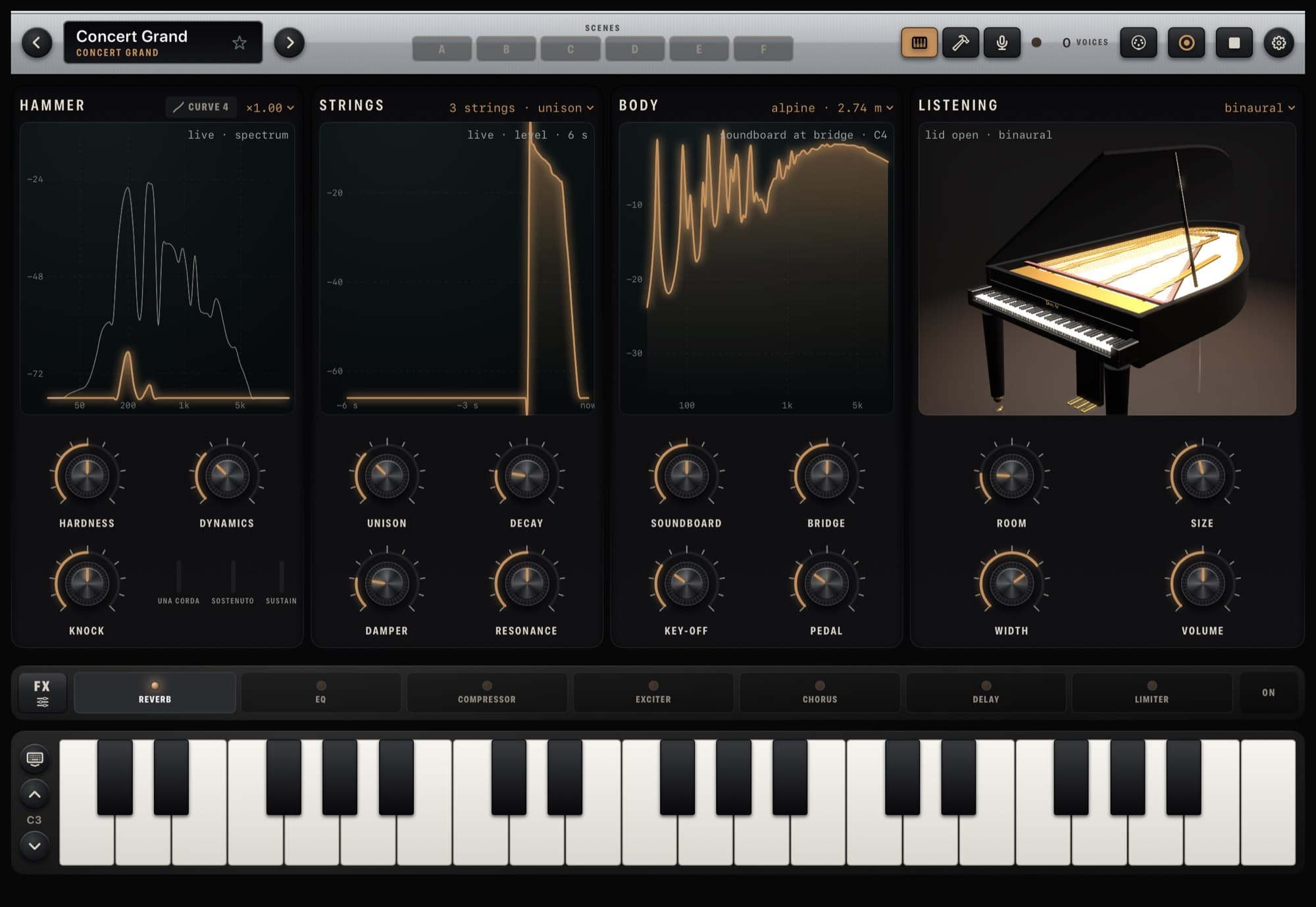
There are no recorded velocity layers: hit harder and the felt compresses and the tone opens, from a velvet pianissimo to a steely fortissimo, with no step between one layer and the next. The strings of each key ring together at the bridge, the soundboard sings after the strike and, with the pedal down, the whole piano resonates. You build your own piano in Builder — a grand or an upright, the soundboard wood, hammers, strings, tuning and condition, down to key by key — and you choose how to listen: up to eight microphones around the piano, or binaural on headphones, in a room of whatever size you like.
Plus a rack voiced for piano, 46 factory sounds, six scenes per sound and MIDI Learn for the stage. No account, no subscription, no tracking: the sound is calculated 100% on your device.
Screens
Features
Physical modelling, not samples
No recorded velocity layers: hit harder and the felt compresses and the tone opens, from a velvet pianissimo to a steely fortissimo, with no step between layers. The strings of each key ring together at the bridge, the soundboard sings after the strike and, with the pedal down, the whole piano resonates. There is no library to download: the app is light and switches sounds instantly.Read moreShow less
Build your own piano
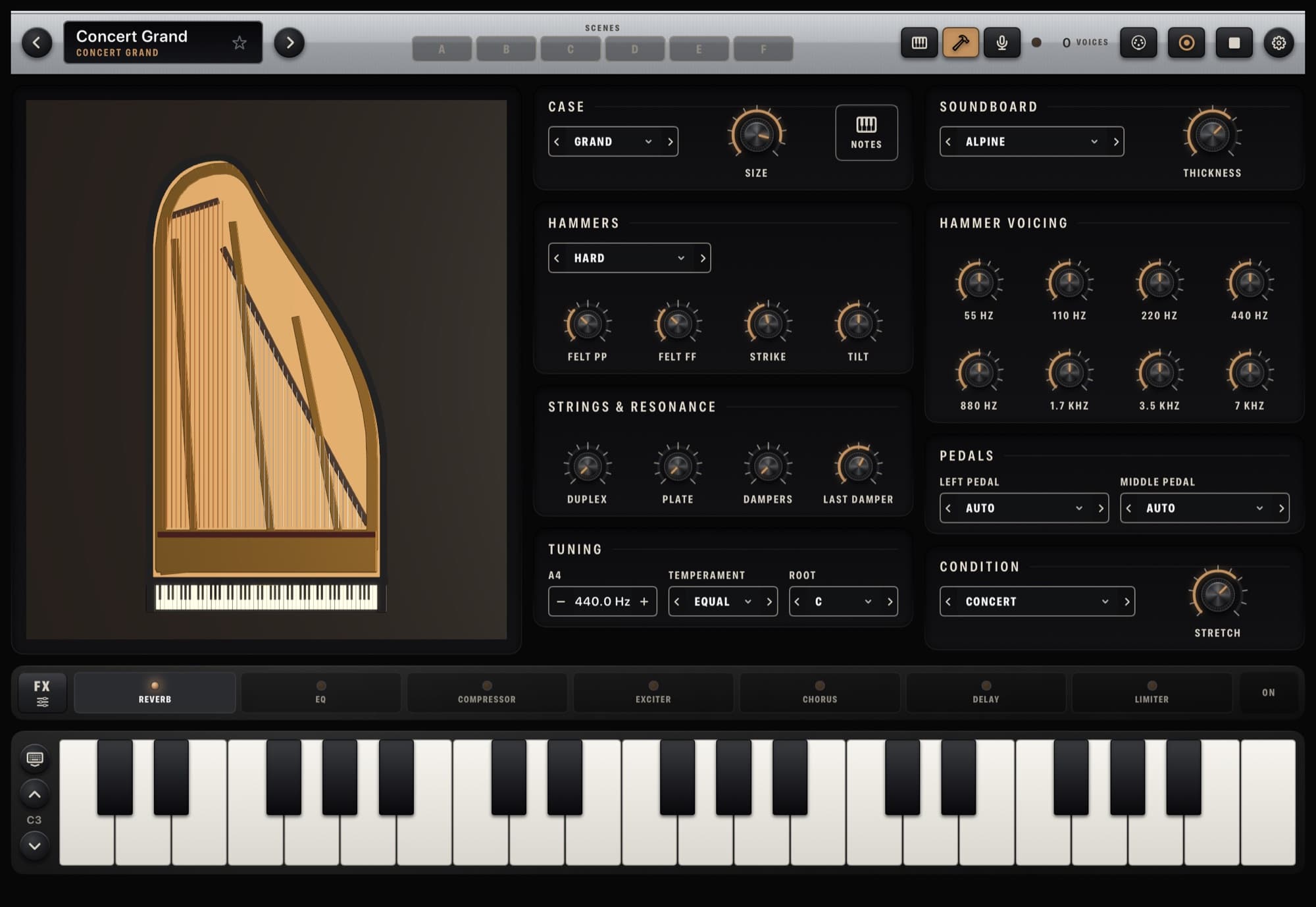
In Builder you choose the parts and the piano is recalculated around them: the model (a grand, from living-room to concert size, 1.5 to 2.9 m, or an upright, with its height and distance from the wall), the soundboard (four woods and the thickness), the hammers (five felts, from soft to lacquered, plus Felt, the felt-piano strip; the hardness at pp and ff and the strike point), the strings and dampers (unison, sustain, resonance, duplex, the damper position), the tuning (pitch, stretched tuning and seven historical temperaments) and the condition, from a brand-new piano to a saloon one.Read moreShow less
Key by key
The tuning, level, hammer, sustain and unison of each of the 88 keys, the way a technician voices them — or a ready-made profile: warm bass, singing treble, well-worn, honky-tonk. The regulation belongs to the sound: it is saved with it, goes into Compare and travels in the DAW project.Read moreShow less
Choose how you listen
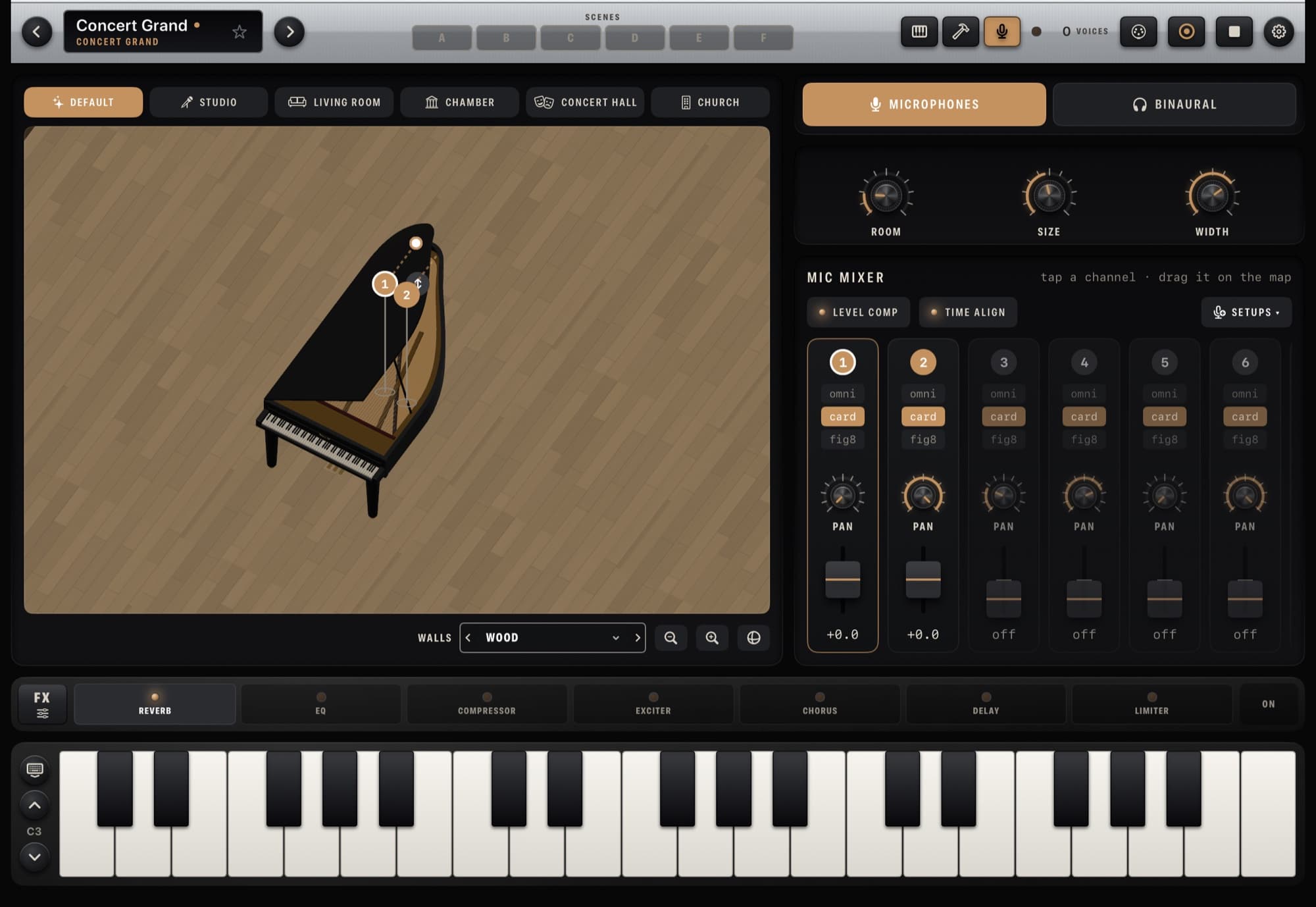
Place up to eight microphones around the piano, each with its own pattern (omni, cardioid, figure-8), level and pan — or listen binaural on headphones, with the head wherever you like. Or start from a ready-made setup, the ones engineers use: spaced pair, XY, ORTF, Blumlein, a three-omni tree, close pop/jazz, a mic under the soundboard, the audience pair and the player’s ears. Pick the room — studio, living room, chamber, concert hall or church —, drag its corner to resize it and change the walls: wood, plaster, stone, curtains or studio. The lid opens and closes.Read moreShow less
Real pedals
Continuous sustain (half-pedalling works), sostenuto and una corda. And the rarer pedals, for exploring: celeste, harmonic, Mozart rail, buff stop, super sostenuto, rattle and pinch harmonic.Read moreShow less
A piano rack
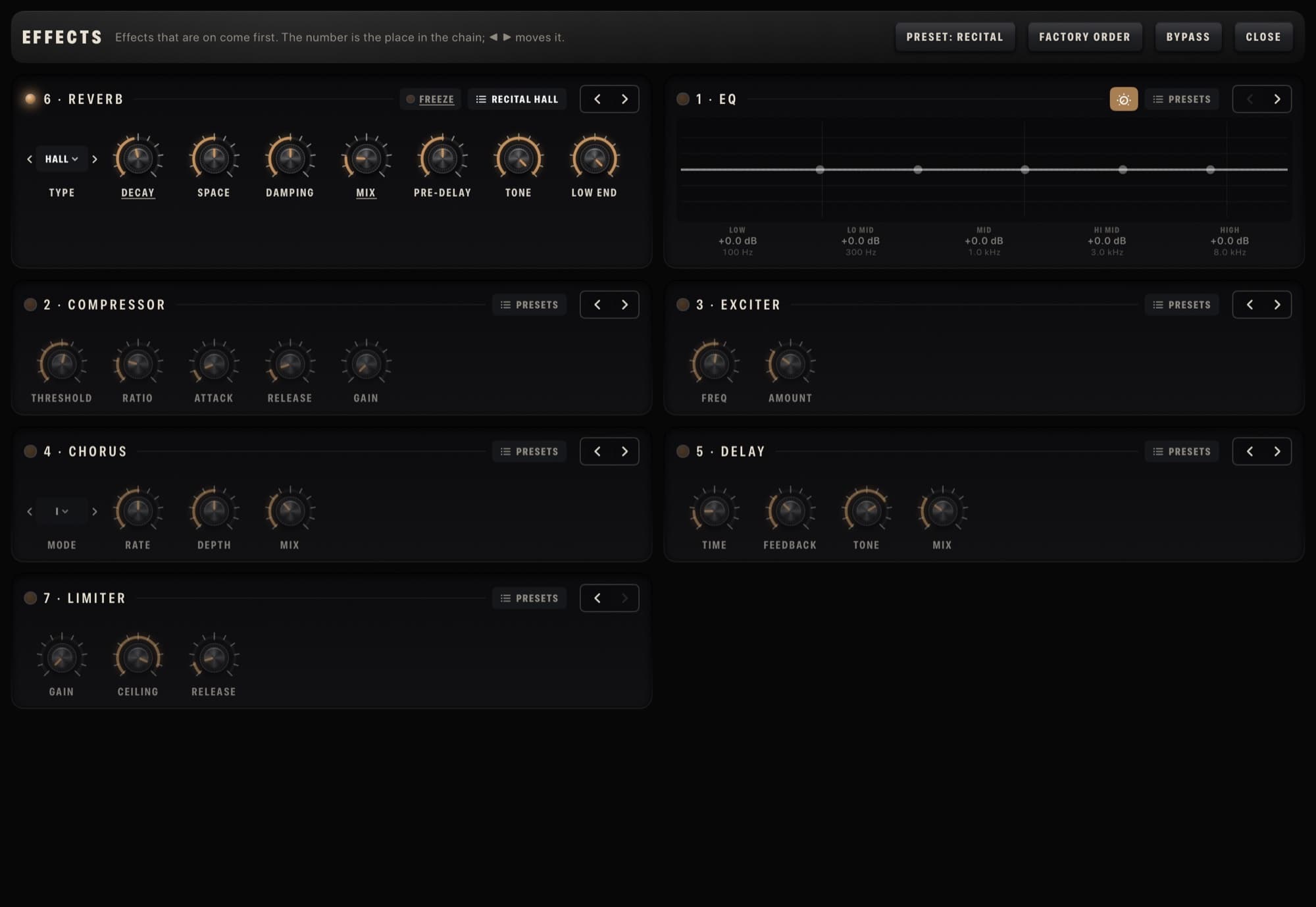
5-band EQ, compressor, exciter, an 8-mode chorus, delay, a reverb with 9 spaces and a limiter. 34 effect presets change the effects without touching the piano.
Show the other 4 featuresShow fewer
Built for the stage
Six scenes per sound (A–F). MIDI Learn on any control. Nine velocity curves plus Fixed, sustain, sostenuto and una corda over MIDI, Program Change and PANIC. One voice per key, as on a piano: a ringing note is never cut to make room for another.Read moreShow less
46 factory sounds
In 6 banks: Concert Grand, Studio Grand, Parlor Grand, Upright, Character and Stage & FX — every wood, felt, condition, room and effect appears in at least one. Favourites, search, tags, import and export — and your sounds stay yours when the app updates.Read moreShow less
App and AUv3 plug-in
Play it as an AUv3 instrument in GarageBand, Logic, AUM, Cubasis and any host — sounds, scenes and MIDI maps are the same in the app and in the plug-in. Open the app once after installing and ask your host to rescan plug-ins: that is what registers the Audio Unit. Turn on the guided tour and touch any knob to hear what that part does.Read moreShow less
Private by design
No account, no subscription, no tracking. The sound is calculated 100% on your device. One-time purchase.
FAQ
Is there an acoustic piano for iOS (iPhone and iPad)?
Yes — coming soon to the App Store. Tonic AP is a physically modelled acoustic piano for iOS and Mac: a grand and an upright calculated note by note, with no samples and no velocity layers, with eight microphones, an adjustable room and AUv3 (GarageBand, Logic, AUM, Cubasis and other hosts). With no library of recordings to download, the app is light and switches sounds instantly. One-time purchase, no subscription.
Does Tonic AP use samples?
No. Every note is calculated on the spot, from the hammer, the strings and the wooden soundboard — there are no recordings and no velocity layers. That is why the tone changes continuously from pianissimo to fortissimo, and why there is no library to download: the app is light and switches sounds instantly.
Which pianos does it have? Can I build my own?
Two kinds of piano in one app: the grand — from living-room to concert size, 1.5 to 2.9 m — and the upright. In Builder you choose the model, the soundboard wood and thickness, the felts and the hardness of the hammers, the strings and dampers, the tuning and the condition of the piano (from new to saloon), and you can even voice it key by key. To start you off, there are 46 factory sounds in 6 banks.
Does it work as a plug-in?
Yes. It runs as an AUv3 instrument in GarageBand, Logic, AUM, Cubasis and other hosts, and also as a standalone app. Open Tonic AP once after installing, then have your host rescan its plug-ins — that is what registers the Audio Unit. Sounds, scenes and MIDI maps are the same in the app and in the plug-in.
How do the microphones and the binaural listening work?
You place up to eight microphones around the piano, each with its own pattern (omni, cardioid, figure-8), level and pan — or start from a ready-made setup (spaced pair, XY, ORTF, Blumlein, a three-omni tree, close pop/jazz, a mic under the soundboard, the audience pair and the player’s ears). On headphones you can listen binaural, with the head wherever you like. The room is yours too: studio, living room, chamber, concert hall or church, with adjustable size and walls.
Which effects does it include?
A rack voiced for piano: 5-band EQ, compressor, exciter, an 8-mode chorus, delay, a reverb with 9 spaces and a limiter. 34 effect presets change the effects without touching the piano.
What is the difference between Tonic EP and Tonic AP?
Tonic EP is a physically modelled electric piano (tine, reed and E.Grand), with a suitcase amp and a rack for keys. Tonic AP is a physically modelled acoustic piano: a grand and an upright, with hammers, strings, soundboard, microphones and a room you adjust. They are independent apps, from the same Tonic family.
Is there a subscription or data collection?
No account, no subscription and no tracking; the sound is calculated 100% on your device, and the app is a one-time purchase. Nothing leaves your device.
Which devices does it run on?
iPhone, iPad and Mac (native app) — coming soon to the App Store.
When does it launch?
Coming soon to the stores. Follow @rsjb_app for the launch announcement.
What it's for
Tonic AP is a physically modelled acoustic piano for iOS (iPhone and iPad) and Mac. Instead of playing back recordings, it calculates every note the moment you play it — the hammer, the strings and the wooden soundboard become equations — which is why there are no velocity layers: the harder you play, the more the tone opens, continuously, from a velvet pianissimo to a steely fortissimo. You build your own piano in Builder — a grand, from living-room to concert size, or an upright; four soundboard woods; five hammer felts; unison, dampers and resonance; stretched tuning and seven historical temperaments; the condition, from a brand-new piano to a saloon one —, voice it key by key, the way a technician does, and choose how you listen: up to eight microphones around the piano, with ready-made setups such as ORTF, XY and Blumlein, or binaural on headphones, in a room of whatever size you like. It has continuous sustain with half-pedalling, sostenuto, una corda and the rarer pedals, a rack voiced for piano (5-band EQ, compressor, exciter, 8-mode chorus, delay, a 9-space reverb and a limiter), 46 factory sounds in 6 banks, six scenes per sound and MIDI Learn on any control. It runs as an app and as an Audio Unit (AUv3) instrument in GarageBand, Logic, AUM, Cubasis and any host — no account, no subscription, no tracking and no ads; the sound is calculated 100% on your device.