Tonic EP
Physically modelled electric piano — tine & reed, AUv3 + standalone — iPhone, iPad & Mac
Tonic EP is a physically modelled electric piano: every note is calculated the moment you play it, from the hammer, the steel and the pickup — not from recordings. It runs as an app and as an Audio Unit (AUv3) instrument in GarageBand, Logic, AUM, Cubasis and any host on iPhone, iPad and Mac. There are no recorded velocity layers: hit harder and the tone changes — the attack opens and the pickup starts to growl, from pianissimo to fortissimo, with no step between one layer and the next. Two instruments in one app: the tine, with a glassy bell on the attack and a long sustain, and the reed, sweet when played softly and barking when hit hard. Switch between them with one tap, without cutting the note that is ringing. From the desk to the suitcase, with stereo tremolo, plus a 16-effect rack voiced for keys, 96 factory sounds, six scenes per sound and MIDI Learn for the stage.
Features
Physical modelling, not samples
Every note is calculated on the spot, from the hammer to the steel reed and the pickup. Hitting harder changes the tone — the attack opens and the pickup starts to growl — continuously, with no step between layers. All 88 keys come regulated one by one, the way a technician would do it on the instrument, and there is no library to download: the app is light and switches sounds instantly.
Tine and reed — two instruments
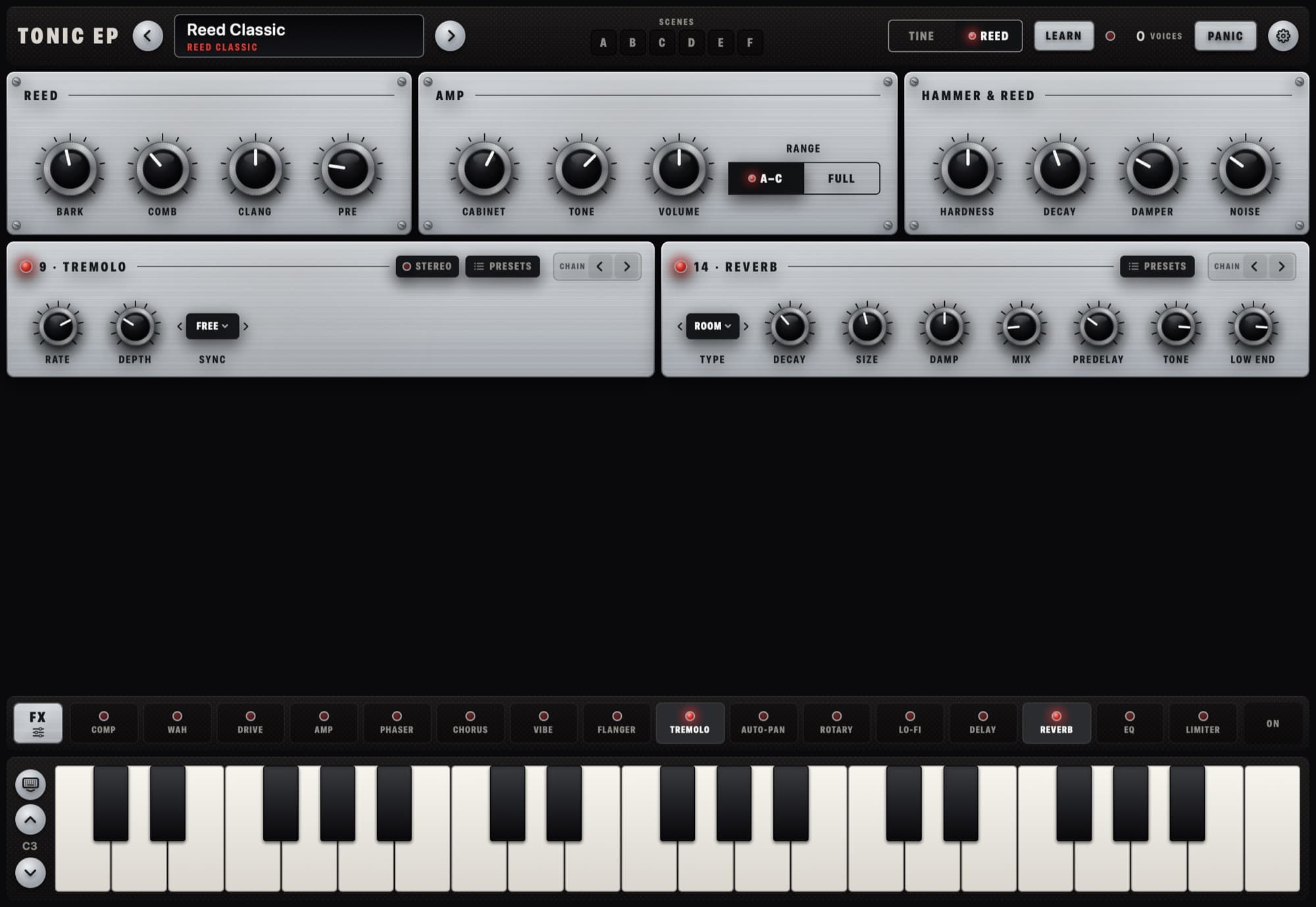
The tine is a steel tuning fork read by a magnet: a glassy bell on the attack, a round body, a growl when you dig in and a long sustain. The reed is a steel reed read by static electricity: sweet when you play softly, nasal in the middle and barking when you hit hard, with the sound of the small speakers in the lid — it plays the original instrument's 64 keys or the whole keyboard. Switch with one tap, without cutting the note that rings.
Voice it like a technician
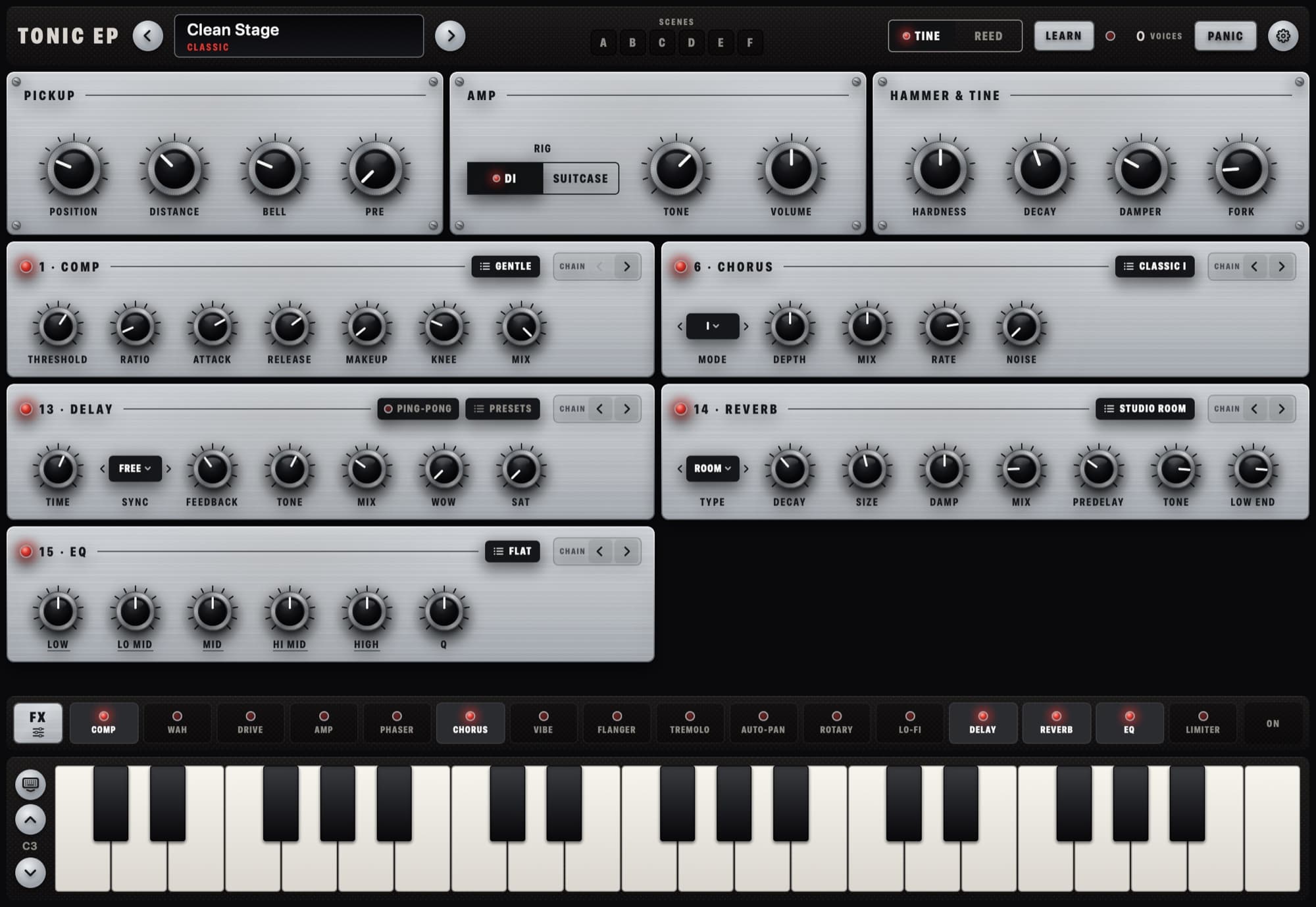
Every knob is a part of the instrument and changes the sound the way the real one would. Tine pickup: Position, Distance, Bell and Pre. Hammer and tine: Hardness, Decay, Damper and Fork. Reed: Bark (from sweet to barking), Comb, Clang and Cabinet (the size of the speaker, from line out to a boxy speaker that barks).
From the desk to the suitcase
Rig DI, straight and clean, or Suitcase: the suitcase amp, which switches on the stereo tremolo — the sound swaying from side to side. The mod wheel rides the tremolo depth.
An electric piano rack
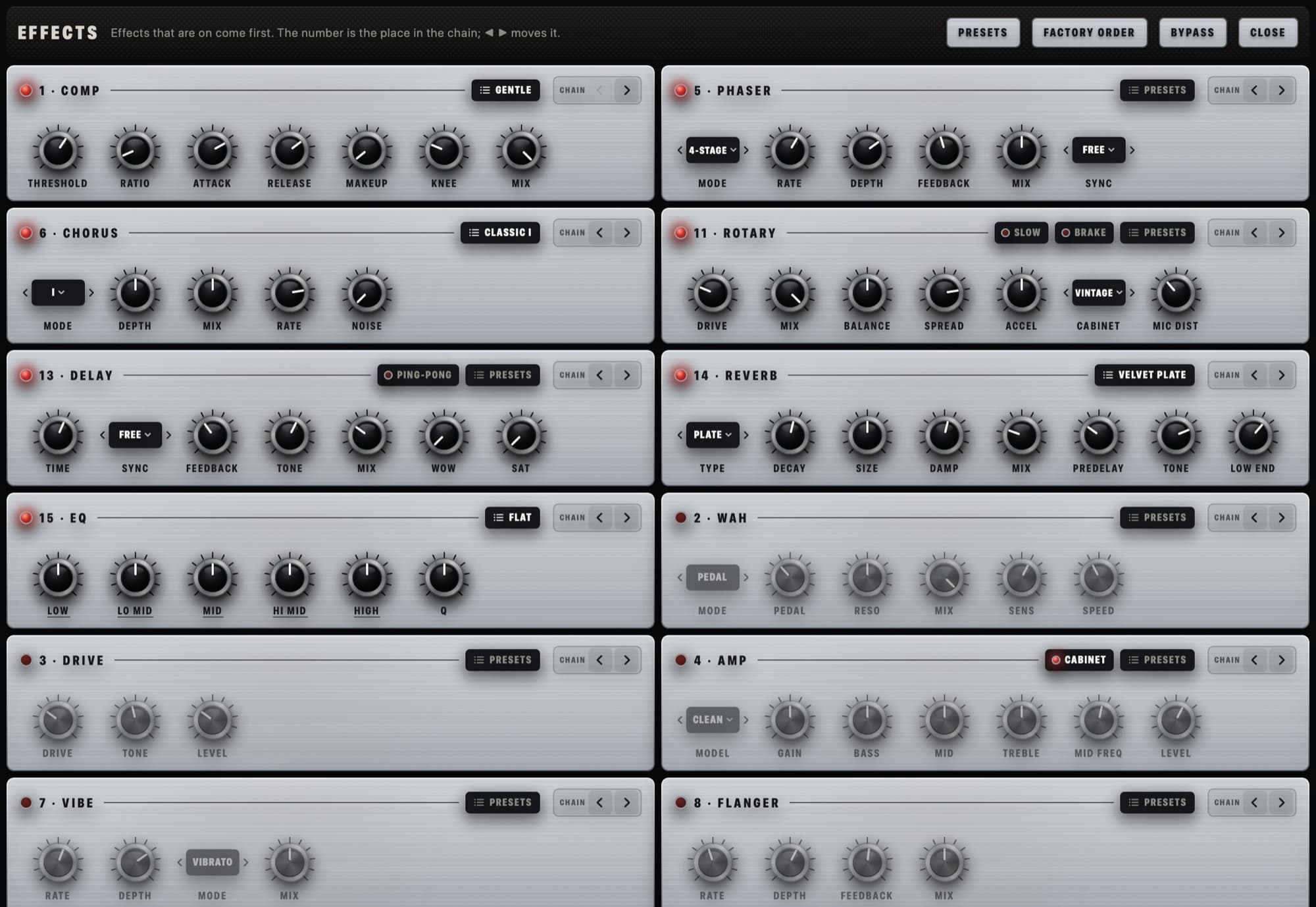
16 effects voiced for keys: compressor, wah (pedal or auto), drive, an amp with 6 models and cabinet, a 4-mode phaser, an 8-mode chorus, vibe, flanger, stereo tremolo, auto-pan, a rotary with 4 cabinets, lo-fi, a tempo-synced ping-pong delay, a reverb with 9 spaces, 5-band EQ and limiter. Switch them on and off and change the order of the chain; 96 effect presets and 17 ready-made chains change the effects without touching the piano.
Built for the stage
Six scenes per sound (A–F). MIDI Learn on any control: one knob on your keyboard drives up to 12 controls at once, each with its own range. Six velocity curves, sustain pedal, pitch bend with separate up and down ranges, volume and expression, Program Change and PANIC. Up to 64 notes at once — and on the Mac, the computer keyboard plays too.
96 factory sounds
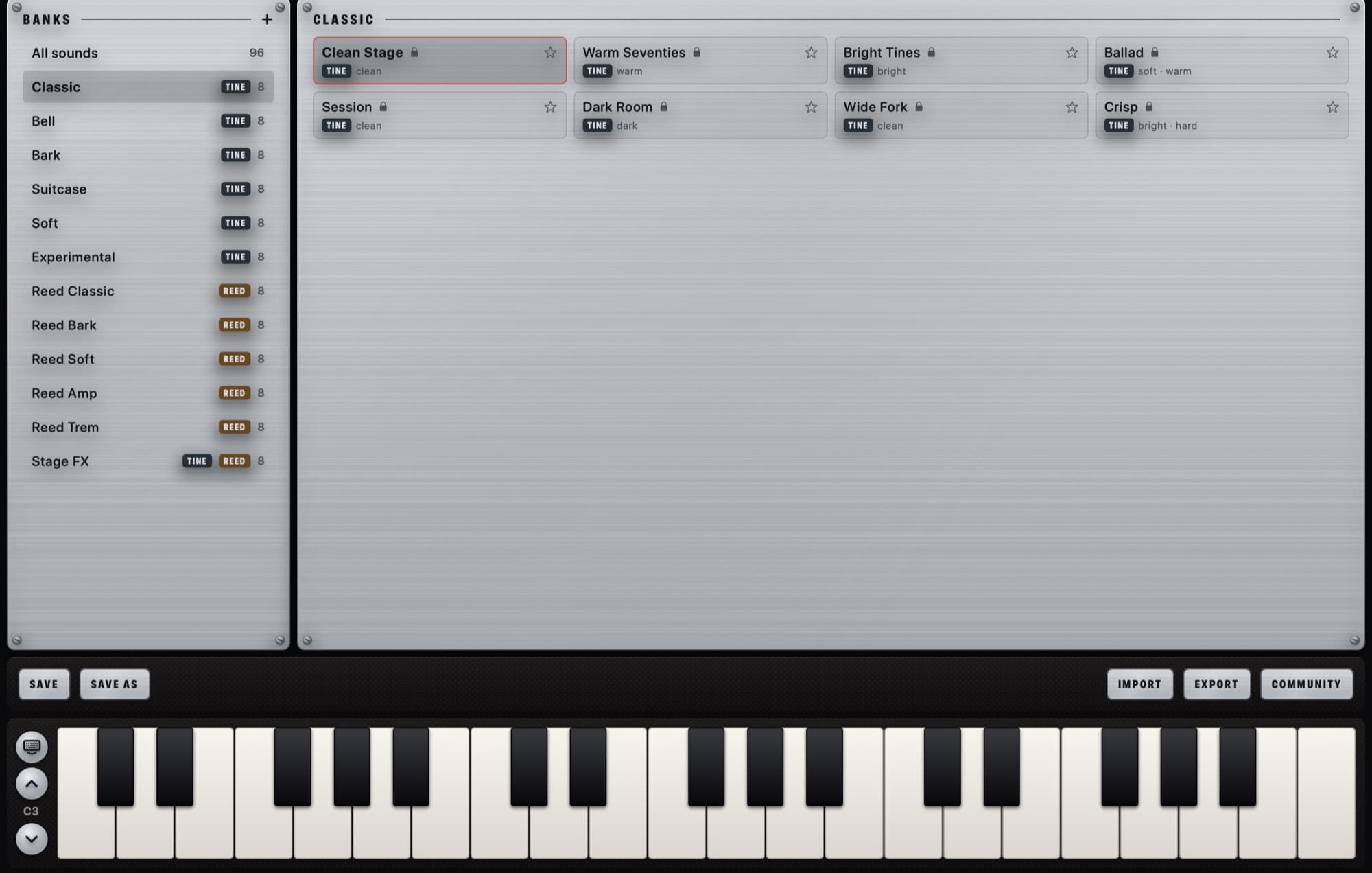
In 12 banks: Classic, Bell, Bark, Suitcase, Soft and Experimental on the tine; Reed Classic, Reed Soft, Reed Bark, Reed Amp and Reed Trem on the reed; and Stage FX, with the effects already dialled in. Favourites, search, tags, import and export — and your sounds stay yours when the app updates.
Sound community
Publish your sounds and download other musicians', hearing each one in the engine itself before you keep it. No sign-up: you pick your nickname once and it follows you on iPhone, iPad and Mac. Optional — the piano works fully offline without it.
App and AUv3 plug-in
Play it as an AUv3 instrument in GarageBand, Logic, AUM, Cubasis and any host — sounds, scenes and MIDI maps are the same in the app and in the plug-in. Turn on the guided tour and touch any knob to hear what that part does.
What it's for
Tonic EP is a physically modelled electric piano for iPhone, iPad and Mac. Instead of playing back recordings, it calculates every note the moment you play it — the hammer, the steel and the pickup become equations — which is why there are no velocity layers: the harder you play, the more the tone changes, continuously. It holds two instruments in one app: the tine (a steel tuning fork read by a magnet, with a glassy bell on the attack) and the reed (a steel reed read by static electricity, sweet when soft and barking when hard). From the desk to a suitcase amp with stereo tremolo, it has a 16-effect rack voiced for keys, 96 factory sounds in 12 banks, six scenes per sound, MIDI Learn and an optional community to publish and download sounds. It runs as an app and as an Audio Unit (AUv3) instrument in GarageBand, Logic, AUM, Cubasis and any host. No account, no subscription and no tracking: the sound is calculated 100% on your device.
See it in action
Screens
FAQ
Does Tonic EP use samples?
No. Every note is calculated on the spot, from the hammer, the steel reed and the pickup — there are no recordings and no velocity layers. That is why the tone changes continuously from pianissimo to fortissimo, and why there is no library to download: the app is light and switches sounds instantly.
What are the tine and the reed?
They are two electric-piano mechanisms. The tine is a steel tuning fork read by a magnet: a glassy bell on the attack, a round body and a long sustain. The reed is a steel reed read by static electricity: sweet when you play softly, nasal in the middle and barking when you hit hard. Tonic EP includes both, and you switch with one tap, without cutting the note that is ringing.
Does it work as a plug-in?
Yes. It runs as an AUv3 instrument in GarageBand, Logic, AUM, Cubasis and other hosts, and also as a standalone app. Open Tonic EP once after installing, then have your host rescan its plug-ins — that is what registers the Audio Unit. Sounds, scenes and MIDI maps are the same in the app and in the plug-in.
Which effects does it include?
16, voiced for keys: compressor, wah (pedal or auto), drive, an amp with 6 models and cabinet, a 4-mode phaser, an 8-mode chorus, vibe, flanger, stereo tremolo, auto-pan, a rotary with 4 cabinets, lo-fi, a tempo-synced ping-pong delay, a reverb with 9 spaces, 5-band EQ and limiter. You can switch them on and off and reorder the chain, and there are 96 effect presets and 17 ready-made chains.
How does the community work? Do I need an account?
There is no sign-up. You pick a nickname once and it follows you on iPhone, iPad and Mac. You can publish your sounds and download other musicians', hearing each one in the engine itself before you keep it. It is optional: the piano works 100% offline without it. Only what you publish — the sound, the nickname and an anonymous code — goes to the server, and you can delete what you published whenever you like.
What is the difference between Tonic and Tonic EP?
Tonic is a synthesizer with eight sound engines (physical modelling, analog, wavetable, SoundFont and FM), an arpeggiator and an effects rack. Tonic EP is a dedicated instrument: a physically modelled electric piano with both mechanisms, a suitcase amp and a rack voiced for keys. They are independent apps.
Is there a subscription or data collection?
No account, no subscription and no tracking; the sound is calculated 100% on your device, and the app is a one-time purchase. The only thing that leaves your device is what you choose to publish to the community, which is optional.
Which devices does it run on?
iPhone, iPad and Mac (native) — coming soon to the App Store.
When does it launch?
Coming soon to the stores. Follow @rsjb_app for the launch announcement.